
Surprising statistic: many people assume that sending a “private” coin automatically makes their transaction invisible. In practice, privacy is a stack of defenses — cryptographic designs, network choices, client behavior, and device security — and breaking any layer weakens the whole. This article unpacks how anonymous transactions work in today’s mobile wallets, why protocol design (Monero, Haven, MimbleWimble) matters, and what realistic privacy looks like for a US-based user choosing a privacy-first multi-currency wallet.
We’ll correct common misconceptions, reveal the mechanisms that produce privacy in different coins, compare trade-offs, and offer a compact decision framework you can reuse when selecting features: threat model, isolation, linkability, and recoverability. Wherever the evidence is partial or conditional, I’ll say so.
How “anonymous” really works: mechanisms behind common privacy coins
Privacy is not a single magic property; it’s a set of mechanisms that reduce linkability between sender, recipient, and amounts. Broadly speaking:
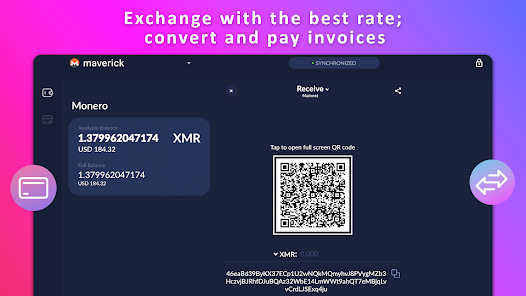
– Monero (XMR) uses ring signatures, stealth addresses (subaddresses), and confidential transactions (ringCT) to hide which input in a ring is real, and to mask amounts. That makes transaction graph analysis far less useful compared to Bitcoin. But note the private view key: if leaked, it exposes incoming transactions. Good wallets keep the private view key on-device and never expose it; Cake Wallet explicitly ensures the private view key never leaves the device, which preserves that layer of protection.
– Haven Protocol (Haven, XHV) is a fork of Monero with added features that aim to create on-chain “stable” assets and custody-like private synthetic assets. It inherits Monero’s privacy primitives but layers additional conversion mechanics; this creates both privacy opportunities and new attack surfaces where linkage can occur during conversions between asset types. The mechanism works best when conversions are performed within a single trusted client and without leaking metadata to third-party services.
– Bitcoin privacy depends on wallet behavior and optional protocols: PayJoin v2 (PJ v2) changes the shape of a transaction to hide which inputs belong to which user; Silent Payments use blinded addresses to reduce address reuse; UTXO coin control and batching reduce unnecessary linking. Bitcoin lacks native confidential transactions in the base layer, so privacy relies on coordination (coinjoins, PayJoin) and client controls.
What mobile wallets add — and why device security matters
Mobile wallets bundle cryptographic primitives and network choices, but their privacy depends on device-level protections. Device-level encryption and authentication — Secure Enclave on iOS or TPM on Android — provide hardware-backed protection for keys and data. If a wallet stores a private view key or seed phrase in encrypted storage bound to the device, that materially raises the cost for an attacker who steals the phone.
Cake Wallet, for example, uses device-level encryption and local 4–6 digit PINs or biometrics. Combined with an open-source, non-custodial architecture, this means keys never leave the device or the app’s control. That eliminates server-side key exposure, but not all risks: physical theft plus unlocked biometrics, malware on the device, or careless backups can still leak secrets.
Network anonymity: Tor, I2P, and custom nodes
Even the best cryptography can be undermined by network-level metadata: IP addresses, timing correlations, and node logs. Wallets that offer Tor-only mode, I2P proxy support, and user-selected custom nodes reduce the chance that an observer can link your IP to a specific transaction. Using a private node you control is best practice if you can run one, because it removes the trust placed in public nodes.
But there are trade-offs. Tor and I2P can increase latency and sometimes cause connectivity problems, especially on mobile data networks. Moreover, wallet developers must be careful: if a wallet’s node discovery leaks your IP to a remote service or uses a default set of centralized nodes, you lose the network anonymity advantage. A strict no-telemetry policy mitigates that risk; Cake Wallet operates under zero data collection, which reduces accidental metadata leakage from the app itself.
Comparing privacy features across assets: Monero, Haven, Litecoin (MWEB), and Zcash
Not all privacy is the same. Monero’s privacy is protocol-native: the defaults are designed to obfuscate. Litecoin’s MWEB (MimbleWimble Extension Blocks) offers an optional privacy layer — beneficial, but optional — and it relies on activation and the coin selection choices of the wallet. Cake Wallet supports MWEB for Litecoin, letting users opt-in to that privacy layer.
Zcash (ZEC) presents a special case: it has both transparent and shielded pools. Mandating shielding by default for outgoing transactions (as Cake Wallet does) is an important protection because using transparent addresses undermines privacy. However, Zcash’s shielded set is historically smaller than the transparent set; the resulting anonymity set can be smaller depending on usage patterns. That’s a practical limitation: mandatory shielding reduces common user mistakes but cannot by itself create a large anonymity set.
Hardware integration and air-gapped signing: the Cupcake and Ledger option
For a US user worried about theft, legal seizure, or targeted malware, integrating a hardware wallet closes many practical attack vectors. Cake Wallet supports Ledger devices and an air-gapped solution called Cupcake. Hardware signing ensures private keys never touch a network-connected device, and air-gapped workflows eliminate remote exfiltration risks.
The trade-off is convenience. Air-gapped setups are slower and require discipline: maintaining firmware, secure physical storage, and clear recovery plans. They also complicate mobile-first flows like in-app swaps. If you value high-assurance custody, accept slower UX; if you prioritize quick on-device swaps, weigh the trade-off carefully.
Built-in swapping and NEAR Intents: privacy vs convenience
Built-in exchange features and NEAR Intents’ decentralized routing make on-device swaps fast and often competitive. They remove the need to trust centralized exchanges. Still, swaps can leak metadata: if your swap path includes centralized market makers or intermediary services, counterparty analytics could observe amounts, timing, and possibly on-chain flows that reduce privacy.
Decentralized routing reduces but does not eliminate those risks. A useful heuristic: for small, routine swaps the privacy cost is low if performed inside a non-custodial client that uses Tor or custom nodes; for large or sensitive conversions, favor on-chain privacy-preserving methods (e.g., stay within Monero/Haven pools) or route through multiple privacy-preserving steps.
Common misconceptions and corrections
Misconception 1: “Using Monero once guarantees forever anonymity.” Correction: Monero provides strong unlinkability at the protocol level, but operational mistakes (reusing subaddresses, revealing the private view key, or transacting with KYC custodial services) can create links. The wallet’s role — keeping keys local, supporting subaddresses, and running background sync — reduces user error.
Misconception 2: “Tor mode makes everything anonymous.” Correction: Tor hides IPs but timing analysis and application-layer leaks can still identify users. Combining Tor with local node control, no telemetry, and sound key hygiene provides the stronger end-to-end protection.
Misconception 3: “All privacy coins are interchangeable.” Correction: they differ in anonymity set, mechanism, and practical risks. Haven’s asset conversion features add functionality but also potential linkage points; Litecoin’s MWEB is optional; Zcash’s shielded pool size matters. Choose the coin to match the threat model, not the marketing.
Practical decision framework: four questions to choose a privacy wallet and workflow
Ask these in order before you move funds:
1) What is my threat model? (Casual privacy vs targeted surveillance vs legal seizure.)
2) Which layer is my weakest link? (Device compromise, network visibility, or exchange counterparty.)
3) Do I need cross-chain swaps or will staying within a native privacy chain be safer?
4) Can I maintain hardware backups, air-gapped signing, and a recovery plan safe from coercion?
Applying this framework, a typical privacy-conscious US user who fears casual chain analysis but not targeted state surveillance will benefit from a wallet that combines Monero native privacy, Tor connectivity, hardware integration, and a no-telemetry policy. For readers interested in a practical Monero client with those features, consider the options listed on a reputable monero wallet page to compare UI, sync modes, and hardware support.
Where privacy breaks: realistic limitations and unresolved issues
Even with the best tools, privacy can be eroded by: chain-level linkages when converting between different asset types; metadata leaks from swap providers; compromised backups; and legal processes that can compel service providers to reveal logs (if they have any). Some unresolved debates remain: how to measure effective anonymity set across mixed-asset swaps; the long-term privacy impact of large, infrequent shielded-to-transparent conversions; and the interplay between off-chain liquidity routing and on-chain privacy.
Importantly, some technical solutions are still immature. Larger anonymity sets on Zcash require more adoption of shielded addresses; MWEB’s privacy depends on wallet-level adoption; and Haven’s expanded features create new research questions about indistinguishability during conversions. These are active areas of development, not settled facts.
What to watch next
Signals that matter: rising adoption of shielded pools (ZEC) or MWEB usage (LTC) increases anonymity sets; wider wallet support for PJ v2 and Silent Payments improves Bitcoin privacy; more air-gapped and hardware-combo UX improvements reduce the friction of high-assurance workflows. Also watch regulatory signals in the US that could change the operational risk for custodial swap partners — such rules affect the privacy properties of in-app exchanges regardless of the wallet’s local controls.
If you care about long-term privacy, prefer clients that: 1) keep keys and private view keys on-device, 2) support Tor/I2P and custom nodes, 3) offer hardware wallet integration, and 4) document a strict no-telemetry stance. Those properties raise the baseline bar for resistance against both passive chain analysis and active compromise.
FAQ
Q: Is Monero truly anonymous if I use a mobile wallet?
A: Monero’s protocol is designed for strong on-chain privacy, and a mobile wallet that keeps private keys and the private view key on-device (and supports subaddresses and background sync) preserves much of that protection. However, device compromise, careless backups, or network leaks (IP/timing) can still undermine anonymity. Use Tor/I2P, hardware signing if possible, and avoid exposing view keys.
Q: How does Haven Protocol differ from Monero in privacy terms?
A: Haven borrows Monero’s base privacy mechanics but adds asset-conversion features to create synthetic private assets. That can be useful, but conversions are additional operations where linkage can appear if handled by external services. The safest approach is to keep conversions within a single trusted client and minimize reliance on third-party intermediaries.
Q: Are in-app swaps dangerous for privacy?
A: Not inherently, but they can leak metadata to counterparties in the swap route. Decentralized routing via systems like NEAR Intents reduces centralization risk, but for high-sensitivity amounts, consider on-chain privacy-preserving routes or multiple privacy steps rather than a single large in-app swap.
Q: What is the single most useful habit to improve transaction anonymity?
A: Discipline with keys and network choices: keep seeds and the private view key offline or on hardware, avoid reuse of addresses (use subaddresses), enable Tor/I2P or run your own node, and don’t move large amounts through custodial KYC services if you want unlinkability.